
Hello, Welcome
Hi, Hello. This is an example note feature included with Astro Cactus 🌵
They’re for shorter, more concise posts that you’d like to share. They generally don’t include headings, but hey, it’s entirely up to you!
Hi! I'm Ansh and I am currently working in the AI policy space for the UK Civil Service. I previously worked at the Parliamentary Office of Science and Technology (POST) where I produced an AI policy briefing for MPs and Peers. I hold a PhD in Theoretical Particle Physics from Durham University, having researched some of the mysteries at the beginning of time.
Find me on
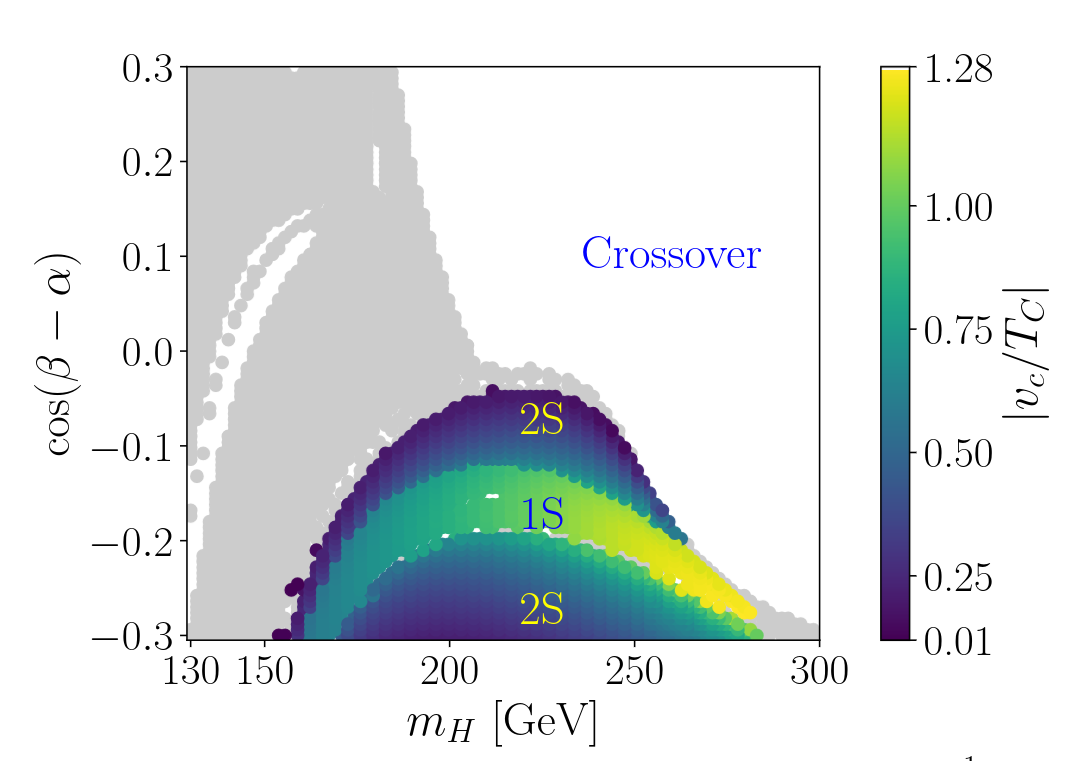
We investigate if the recent mass resonance excesses seen around 95 GeV at the Large Hadron Collider (LHC) can be reconciled with a first-order electroweak phase transition. Performing the first large-scale parameter scan of the Type I Two Higgs Doublet Model (2HDM) using high-temperature dimensionally reduced effective field theory, we focus on regions of parameter space consistent with interpreting the excess as an additional pseudoscalar state. We find that, in contrast to the Standard Model, the electroweak transition pattern in the 2HDM is generically first-order, proceeding either in a single or in two steps. While transition strengths can reach up to vc/Tc ∼ 1.3, the viable, collider-constrained parameter space yields vc/Tc ≲ 1. Thus, the gravitational wave signals lie below the projected reach of future interferometer experiments and are likely insufficient to support successful electroweak baryogenesis.
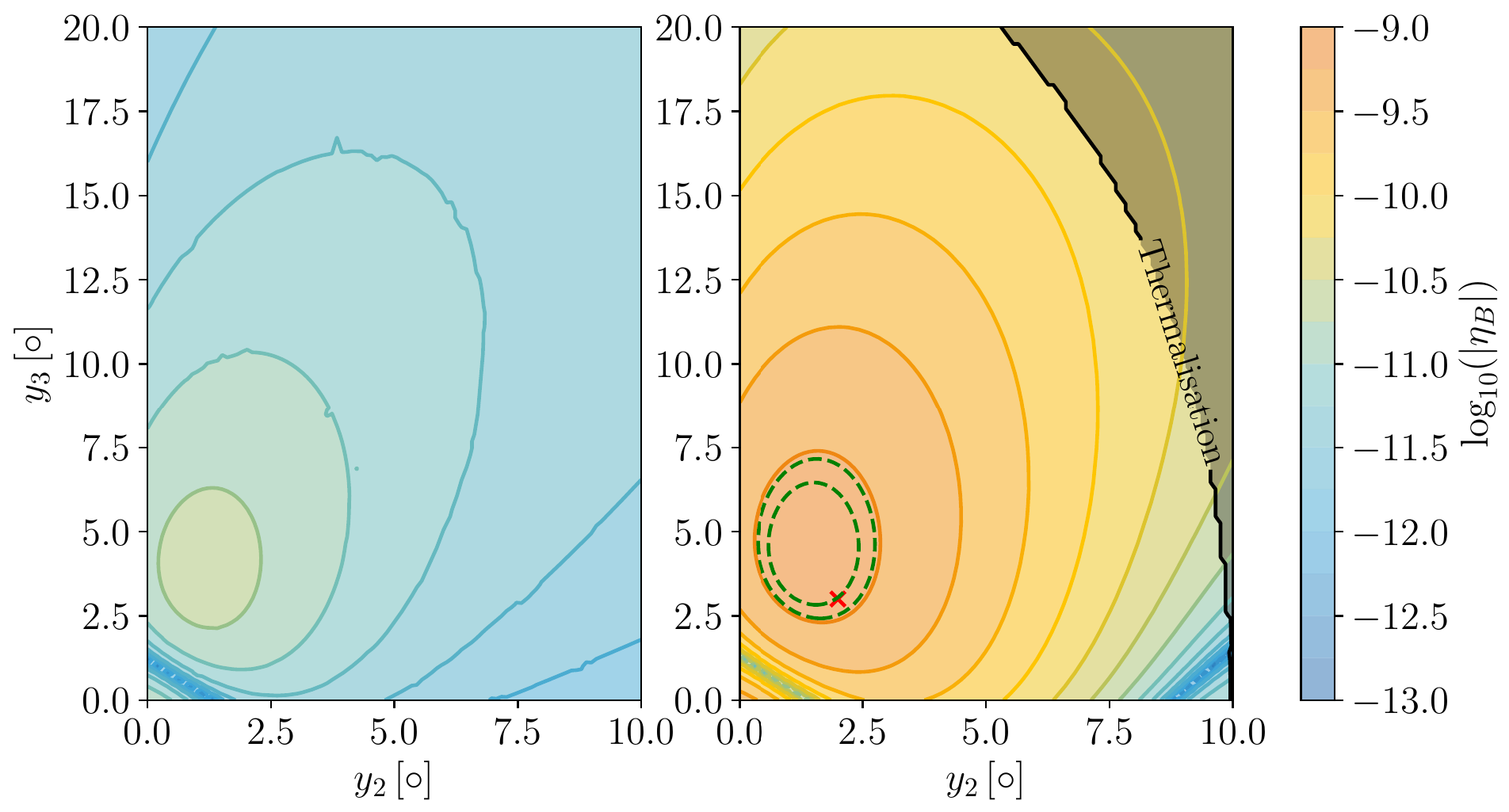
We investigate a class of leptogenesis scenarios in which the sector containing the lightest right-handed neutrino establishes kinetic equilibrium at a temperature > TSM, where TSM is the temperature of the Standard Model sector. We study the reheating processes which realise this “hot leptogenesis” and the conditions under which kinetic and chemical equilibrium can be maintained. We derive and solve two sets of evolution equations, depending on the presence of chemical equilibrium within the hot sector, and numerically solve these for benchmark scenarios. We compare the viable parameter space of this model with standard leptogenesis scenarios with a thermal initial condition and find that hot leptogenesis resolves the neutrino and Higgs mass fine-tuning problems present in the standard scenario.
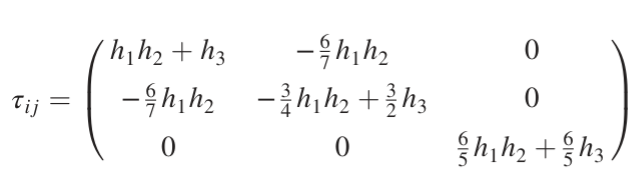
We consider holography of two pp-wave metrics in conformal gravity, their one-point functions, and asymptotic symmetries. One of the metrics is a generalization of the standard pp waves in Einstein gravity to conformal gravity. The holography of this metric shows that within conformal gravity one can have a realized solution which has a nonvanishing partially massless response tensor even for a vanishing subleading term in the Fefferman-Graham expansion (i.e., Neumann boundary conditions) and vice versa.
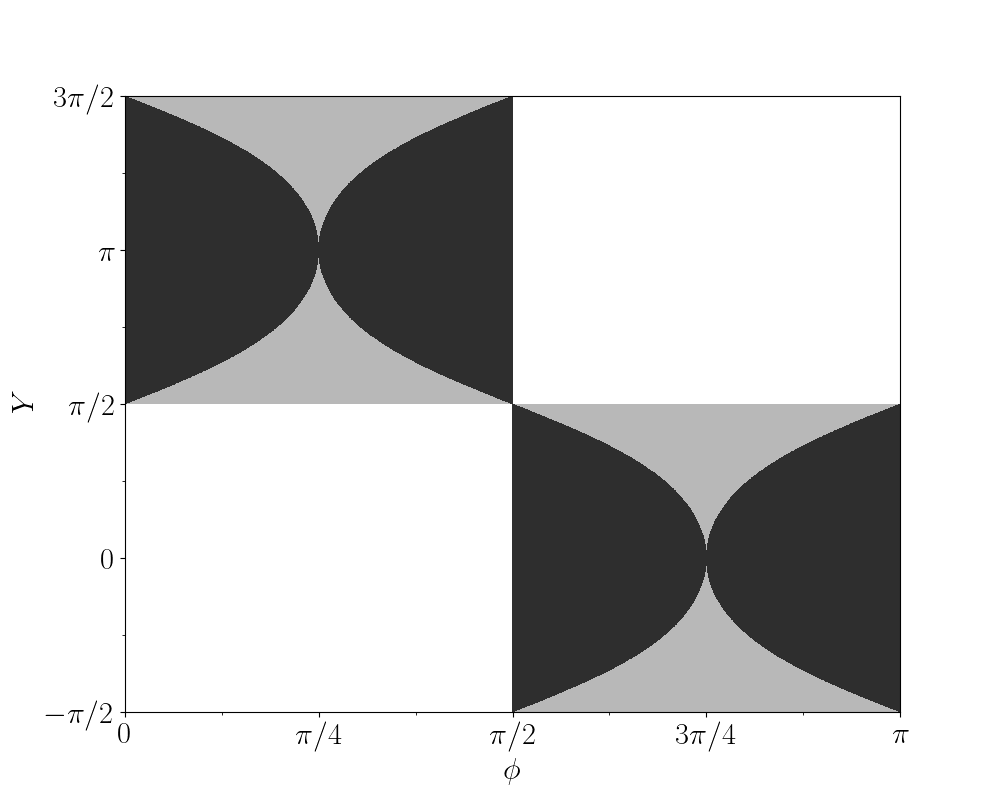
Leggett-Garg (LG) tests for macrorealism were originally designed to explore quantum coherence on the macroscopic scale. Interference experiments and systems modeled by harmonic oscillators provide useful examples of situations in which macroscopicity has been approached experimentally and are readily turned into LG tests for a single dichotomic variable Q. Applying this approach to the double-slit experiment in which a noninvasive measurement at the slits is included, we exhibit LG violations. We find that these violations are always accompanied by destructive interference. The converse is not true in general and we find that there are nontrivial regimes in which there is destructive interference but the two-time LG inequalities are satisfied, which implies that it is in fact often possible to assign (indirectly determined) probabilities for the interferometer paths. Similar features have been observed in recent work involving a LG analysis of a Mach-Zehnder interferometer and we compare with those results. We extend the analysis to the triple-slit experiment again finding LG violations, and we also exhibit examples of some surprising relationships between LG inequalities and NSIT conditions that do not exist for dichotomic variables. For the simple harmonic oscillator, we find an analytically tractable example showing a two-time LG violation with a gaussian initial state, echoing in simpler form recent results of Bose et al. [Phys. Rev. Lett. 120, 210402 (2018)].
Hi, Hello. This is an example note feature included with Astro Cactus 🌵
They’re for shorter, more concise posts that you’d like to share. They generally don’t include headings, but hey, it’s entirely up to you!